
How a Central Air Conditioner Actually Works
Like every true air conditioner, a central system does not make cold, it moves heat. An air handler hidden in your basement or closet pulls warmth out of the household air, carries it through a sealed loop of refrigerant running out through the wall, and a condenser unit outside dumps that heat into the open air.
The Short Answer:
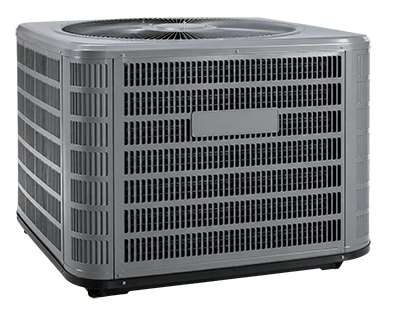
A central air conditioner works by moving heat out of a whole house, not by creating cold. A sealed loop of refrigerant absorbs heat through a coil in the indoor air handler, a compressor in the outdoor condenser unit pumps that heat outside, and the outdoor coil releases it into the open air. The same household air, with its heat removed, blows back through the supply ducts as cool air — one system, every room.
- It removes heat from the house. It does not make cold.
- One outdoor unit, sized in tons (one ton = 12,000 BTU), feeds an indoor air handler that pushes cooled air through ductwork to every room — roughly one ton per 400–600 square feet of well-insulated home.
- A real air conditioner has to vent heat outdoors, which is why the outdoor condenser is not optional — small “personal coolers” with no outdoor unit cannot actually cool a room.
- Any electronic device* that doesn’t vent heat outdoors will in fact produce heat in the room, and while they may fan the user and ‘cool’ them via evaporation on the skin, the room itself does not get colder.
What’s Inside a Central Air System?
It’s a Heat Remover, Not a Cold Making Machine
Once again, cold is not a thing you can make and blow into a house. Cold is just the absence of heat. So a central air conditioner does not create cold air. It grabs the heat already in your home and carries it somewhere else, which in this case is the condenser unit sitting outside on a pad. What blows back out of your registers is the same household air with its heat removed.
It pulls this off with a sealed loop of refrigerant, a fluid that boils and condenses at convenient temperatures, pushed around the loop by a compressor. The four stages, in order, are:
- The evaporator coil sits in the indoor air handler. Cold refrigerant runs through it, the blower pushes warm return air across it, and the refrigerant soaks up that heat. The air that goes back out to the supply ducts is now cooler.
- The compressor, out in the condenser unit, takes that warm, low-pressure gas and squeezes it into a hot, high-pressure gas. This is the part that does the work and draws most of the electricity — the engine of the whole system.
- The condenser coil lines that same outdoor unit. The hot gas gives up its heat to the outdoor air, helped by the big top fan, and turns back into a liquid. This is where your home’s heat actually leaves the building.
- The expansion valve, back at the air handler, lets the pressure drop suddenly, which chills the liquid back down. It returns to the evaporator cold, and the loop starts again.
That loop runs continuously while the system cools. Nothing is used up. The same refrigerant circles forever through the lines, moving heat from inside to outside over and over.
The Parts Inside a Central System
Split the system open and there is less in there than you might expect — it is just shared across two boxes and your ductwork. Every central air conditioner is generally built from the same short list of parts.
Compressor
The sealed pump that drives the whole cycle, housed in the outdoor condenser unit. It is the heaviest, most expensive part, and when it dies the unit is often not worth fixing. Newer systems increasingly use a two-stage or variable-speed compressor that runs at lower output most of the time, which is a big part of why they run so efficiently.
Evaporator and condenser coils
Two grids of thin metal fins, one in the indoor air handler and one in the outdoor unit. Heat moves into the cold coil indoors and out of the hot one outdoors. They need airflow to work, which is why a dirty filter or a coil packed with dust wrecks performance.
Refrigerant lines
The pair of copper lines that run between the indoor air handler and the outdoor condenser to join them into one sealed loop. The thin line carries warm liquid; the thicker, foam-wrapped line carries cold gas back to the compressor.
Refrigerant
The working fluid sealed inside the loop. You should never need to add any. A system that cools well for a while then stops, or that ices up, may be leaking refrigerant, which is a repair, not a top-up you do yourself.
Expansion valve
A small metering valve at the indoor coil. The refrigerant leaves it as a cold, low-pressure liquid ready to soak up heat again.
Two fans, a filter and a drain
The indoor blower moves household air across the cold coil and out through the ducts. The outdoor fan pushes outside air across the hot coil. The filter sits in the air handler or return and is the single thing you can maintain yourself — swap it every month or two and most performance complaints disappear. A condensate drain line carries the moisture that collects on the cold coil away to a drain.
What Size Central System Do You Need?
Cooling capacity is measured in tons, where one ton equals 12,000 BTU. The rough starting point for a well-insulated home is about one ton per 400 to 600 square feet, then a contractor runs a Manual J load calculation that adjusts for ceiling height, sun exposure, windows, insulation and your climate. A 2,000 square foot house often lands somewhere between three and four tons.
Resist the urge to buy too big. An oversized system cools the air fast, shuts off, and never runs long enough to pull the humidity out, so the house ends up cold but clammy — and the short cycling wastes the efficiency you paid for.
Central air can't be sized reliably from a website. The right capacity comes from a Manual J load calculation done in your house, one that accounts for your homes insulation, windows, ceiling height and climate. So the honest next step is a qualified contractor who measures properly and quotes a system that genuinely fits. Get more than one quote, and be wary of any installer who sizes by square footage alone or pushes a bigger system than the calculation calls for. Click below for some information and help.
Central vs Mini-Split vs Window
Central air is not always the best cooling solution, but it is normally the best choice for cooling a whole house evenly and quietly from a single system — provided the ductwork is already there. Here is how it stacks up against the alternatives.
| Type | Best for | Trade-offs |
|---|---|---|
| Central air | Cooling a whole house evenly from one system | Highest cost, needs ductwork throughout, least practical to retrofit |
| Mini-split | A permanent, quiet, efficient room or zone, with no ducts | Costs more up front per zone and usually requires a professional installation |
| Window unit | Cooling one room cheaply, no installer needed | Blocks a window, can be noisy, needs a suitable window |
For a house that already has ducts, or one being built or gut-renovated, central air is the even-handed choice that cools every room from one thermostat. For a home with no ductwork, or just a room or two to cool, a mini-split is quieter to retrofit. For a renter or a quick fix, a window unit is cheaper and needs no installer.
How Much Electricity Does Central Air Use?
Central air is the largest cooling load in most homes simply because it cools the most space. Daily cost depends on the system’s capacity, how long it runs, and your local power rate — but a correctly sized, efficient system holding a steady temperature costs far less to run than an oversized one that short-cycles all afternoon.
The efficiency number to look for is the SEER2 rating. Higher means more cooling per watt, and the gap between a baseline and a high-SEER2 system shows up clearly on a summer power bill. A more efficient unit costs a little more to buy and quietly pays it back. And as with any AC, an oversized system is the expensive one to run, because it never settles into the steady, low-speed running where it is most efficient.
Frequently Asked Questions
Why are some rooms colder than others?
Uneven cooling is almost always a duct problem, not a sizing one. Long runs, leaky joints, crushed flex duct or closed registers starve the far rooms of airflow. Balancing the dampers, sealing the ducts, or adding a return in a stubborn room usually evens things out far more cheaply than a bigger system would.
Does central air use a lot of electricity?
It is the biggest cooling load in most homes because it cools the most space, but a correctly sized, high-SEER2 system is efficient for what it does. An oversized one that short-cycles costs more, not less. Check the SEER2 rating before buying, since a higher number means lower running cost.
How long does a central air conditioner last?
Twelve to seventeen years is typical with basic care, which mostly means changing the filter, keeping the outdoor coil clear, and having it serviced. Oversized units, dirty filters and coastal salt air shorten that, and some brands hold up better than others.
Why does my central AC freeze up?
Ice on the indoor coil almost always means restricted airflow or low refrigerant. The common cause is a clogged filter starving the coil of warm air, which lets condensation freeze instead of draining. Change the filter first, and if it keeps happening, suspect a refrigerant leak.
Can I add central air to a house with no ducts?
You can, but running new ductwork through a finished house is invasive and expensive. In that situation a ductless mini-split — or several — usually gives you the same comfort for less disruption. Central air makes the most sense when the ducts already exist or the house is being built or gut-renovated.